
A target price is the price at which a trader plans to sell and take profit. It is set before the trade starts, alongside a stop, the price at which the trader accepts the trade has failed. Every setup we publish comes with both.
This is different from an analyst price target. An analyst's target is a forecast of where a stock could trade, usually about 12 months out, built from earnings estimates and valuation. A trade target is an exit level for one trade that may last only a few days.
The textbook way to set a target
Most chart pattern guides use a measured move: take the height of the pattern and project it from the point where the price breaks out. It is simple and easy to draw, but it says nothing about how often that distance is actually reached.
How we set targets instead
Our targets come from what past setups of the same pattern actually did.
Take the falling wedge. In our most recent backtest (March to mid-October 2026, out-of-sample), 80% of winning falling wedge setups rose at least 6.14%. That figure is the basis for the target, which is why falling wedge targets sit about 6% above the entry.
The win probability shown on each setup is our estimate of the chance that the price reaches the target before the stop within the two-week evaluation window. Hitting the stop first, or hitting neither, are the other two outcomes.
The stop works differently. It scales with the stock's own average daily range, so a volatile stock gets a wider stop than a quiet one. On recent falling wedge examples that has put the stop roughly 14% below the entry.
Why the target is closer than the stop
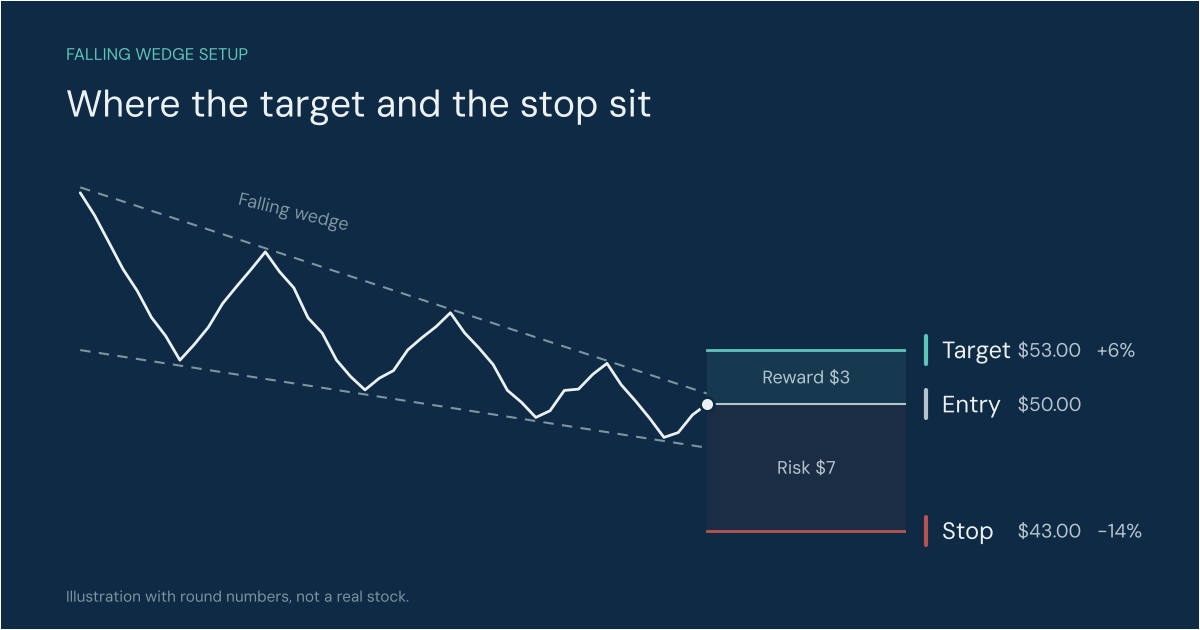
Here is a typical falling wedge setup in round numbers:
| Level | Price | From entry |
|---|---|---|
| Entry | $50.00 | |
| Target | $53.00 | +6% |
| Stop | $43.00 | -14% |
The reward is $3 and the risk is $7, a reward:risk ratio of 0.43. That is a low ratio, and you should read it as one.
With numbers like these, a few wins do not cover one full loss. If every setup ended at either the target or the stop, you would need to win about 70% of the time just to break even. The formula is risk divided by risk plus reward: 7 / (7 + 3).
Real trades are messier than that, because there is a third outcome. A setup can reach neither level inside the window, and it then ends with a small gain or a small loss.
So the ratio alone does not tell you whether a setup is worth taking. It has to be read together with the win rate. In the same backtest, our highest-scoring falling wedge setups won 82.8% of the time (the top 322 of 58,739 setups studied). The win probability shown on each current setup is a more conservative estimate than that.
That is also why we don't select setups on reward:risk alone. For every setup we calculate an expected net return from three outcomes:
- the chance it hits the target first, times the gain to the target
- the chance it hits the stop first, times the loss to the stop
- the chance it hits neither, times the average return of past setups that hit neither
A setup is only considered for the list when those three add up to a positive number. Each stock's page shows the result as Expected Return.
How to use the target
Each setup in the daily email and on each stock's page shows the entry, target, stop, reward:risk and win probability together. Two checks are worth making before anything else:
- Work out the break-even win rate from the reward:risk ratio, as above.
- Compare it with the setup's win probability. The further the win probability sits above break-even, the more room the setup has for error.
You can try this on today's free falling wedge examples. The win probability is an estimate, not a guarantee, and none of this is advice to take any particular trade.
For more on what separates setups that work from those that don't, see our analysis of 370,000 chart patterns.
What is a target price in trading?
A target price is the price at which a trader plans to sell and take profit. It is decided before the trade is opened, together with a stop, the price at which the trader gives up on the trade.
Is a trade target the same as an analyst price target?
No. An analyst price target is a forecast of where a stock could trade, usually about 12 months out, based on the company's earnings and valuation. A trade target is an exit level for one specific trade that may last only days.
Is a reward:risk ratio below 1 bad?
Not by itself, but it means wins must clearly outnumber losses. The break-even win rate is risk divided by risk plus reward. At a reward:risk of 0.43 that is about 70%, if every setup ends at either the target or the stop.
Get every setup before the open
We scan more than 6,000 NYSE and NASDAQ stocks each trading day and email the setups, each with its entry, target and stop, by 6 AM ET. Try it free for 14 days.