
New patternPatterns › Reversal
Trend Dislocation Reversion pattern: rules and success rate
What is a trend dislocation reversion pattern?
A trend dislocation reversion is a reversal pattern, a kind of buy-the-dip or pullback-in-an-uptrend setup, in which a stock in a long-term uptrend is knocked down from a recent high mostly by a broad market sell-off rather than by news of its own, on the expectation that it returns to its trend once the market pressure eases.
Stocks forming a trend dislocation reversion now →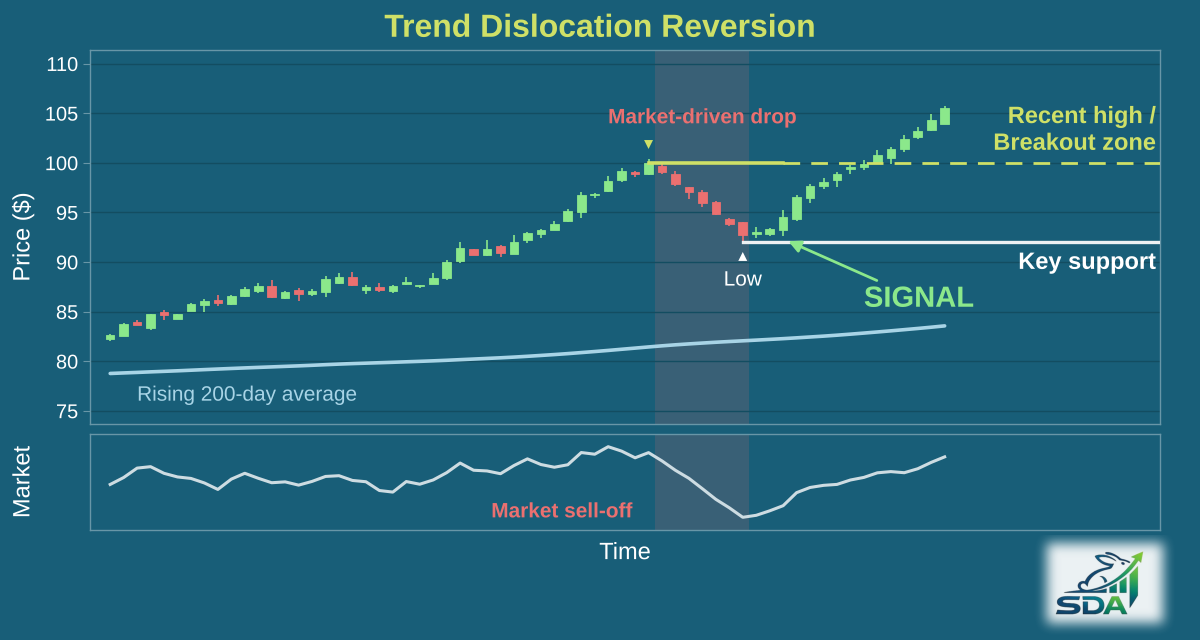
What does a trend dislocation reversion look like?
Our scanner checks it as a setup where all of these hold:
- A rising 200-day moving average: higher today than it was about three and a half months ago.
- A recent high, the highest close in the 30 trading days before the low, above the 200-day moving average.
- The low is the lowest price of the last 13 trading days, so it was made today or within the last 12.
- The drop from the high to the low takes at least 2 trading days and is at least six-tenths of an average daily range deep, so even a shallow dip can count.
- At least half of the drop is explained by the market. We measure how strongly the stock moved with the market over the 60 trading days before the high (its beta); the market's fall times that beta is the market's part, and the stock's own part can't be more than half of the drop.
- A rebound isn't required: it can flag the stock while it is still falling.
- Volume isn't required.
Is a trend dislocation reversion bullish or bearish?
Bullish: a dip in a rising stock that the market caused, not the company. The risk to watch is a market sell-off that keeps going and takes the stock down with it. The uptrend is part of the pattern: our scanner requires a rising 200-day moving average and a recent high above it.
What is the success rate of a trend dislocation reversion pattern?
Our highest-scoring trend dislocation reversion setups won 67.1% of the time in our most recent backtest (March – mid-October 2026, out-of-sample). That covers the top 582 of 30,041 setups studied; a win means the price reached the target before the stop, or closed higher after 10 trading days if neither was hit. Setups cancelled at the open, because the price opened too close to or beyond the target or stop, aren't counted in the win rate. The projected win rate shown on each current detection is a calibrated estimate of a stricter outcome: the chance that the setup reaches the target before the stop within 10 trading days. Setups that reach neither aren't counted as wins there, even if they closed higher. We score every detection on structure, volume, breakout strength, and risk/reward.
How are entry, stop and target set for a trend dislocation reversion setup?
Every pick comes with an entry zone, price targets and a stop. The targets come from how far past trend dislocation reversion setups actually moved, not from a textbook projection of the pattern's height. The stop scales with the stock's own average daily range, so a volatile stock gets a wider stop than a quiet one.
How is a trend dislocation reversion different from a post-collapse recovery?
Both look for a rebound after a drop, but a post-collapse recovery follows a fall of at least 35% from the stock's high of the past year, while a trend dislocation reversion is a short dip, mostly caused by the market, in a stock whose 200-day moving average is still rising.
How is a trend dislocation reversion different from a bull flag?
Both are pauses in a rising stock. Our bull flag needs a rise of at least 5% (the flagpole) and accepts a pause of any shape, while our trend dislocation reversion needs a rising 200-day moving average and a drop that the market mostly explains.
Is trend dislocation reversion a standard chart pattern?
No. It's our name for a setup our scanner looks for: a dip in a stock that is still in a long-term uptrend, caused mostly by a fall in the whole market rather than by anything specific to the company. Traders usually call the general idea buying the dip, or trading a pullback in an uptrend, a kind of mean-reversion trade. Strong stocks dragged down by a broad sell-off are also described as babies thrown out with the bathwater. What our scanner adds is a check on why the stock fell.
How does the scanner tell a market sell-off from company news?
It doesn't read the news. It compares the stock's drop with the market's. First it measures the stock's beta: how much the stock typically moved for each 1% move in the market over the 60 trading days before the high. Beta times the market's fall during the drop is the part the market explains, and the rest is the stock's own. For example, a stock with a beta of 1.5 that fell 6% while the market fell 3% lost 4.5% to the market and 1.5% on its own, so it qualifies. Had it fallen 10%, 5.5% would be its own, more than half of the drop, and the scanner would skip it.
What do the score and win probability mean?
The score, out of 98, ranks how cleanly the pattern formed and how ready it looks to break out. Win probability is our estimate of the chance that a setup like this one reaches the target before the stop within 10 trading days. Setups that reach neither aren't counted as wins. An estimate, not a guarantee.
Where to see current trend dislocation reversion setups
Our latest scan found 18 trend dislocation reversion setups. Free examples, each with its entry, target and stop, are on the news page, updated every trading day. Subscribers get every setup by 6 AM ET.
Other reversal patterns
Get every trend dislocation reversion setup before the open
Tickers, entry zones, targets and stops for every pattern we detect, in your inbox by 6 AM ET.
Start Free Trial →No credit card required · 14 days free